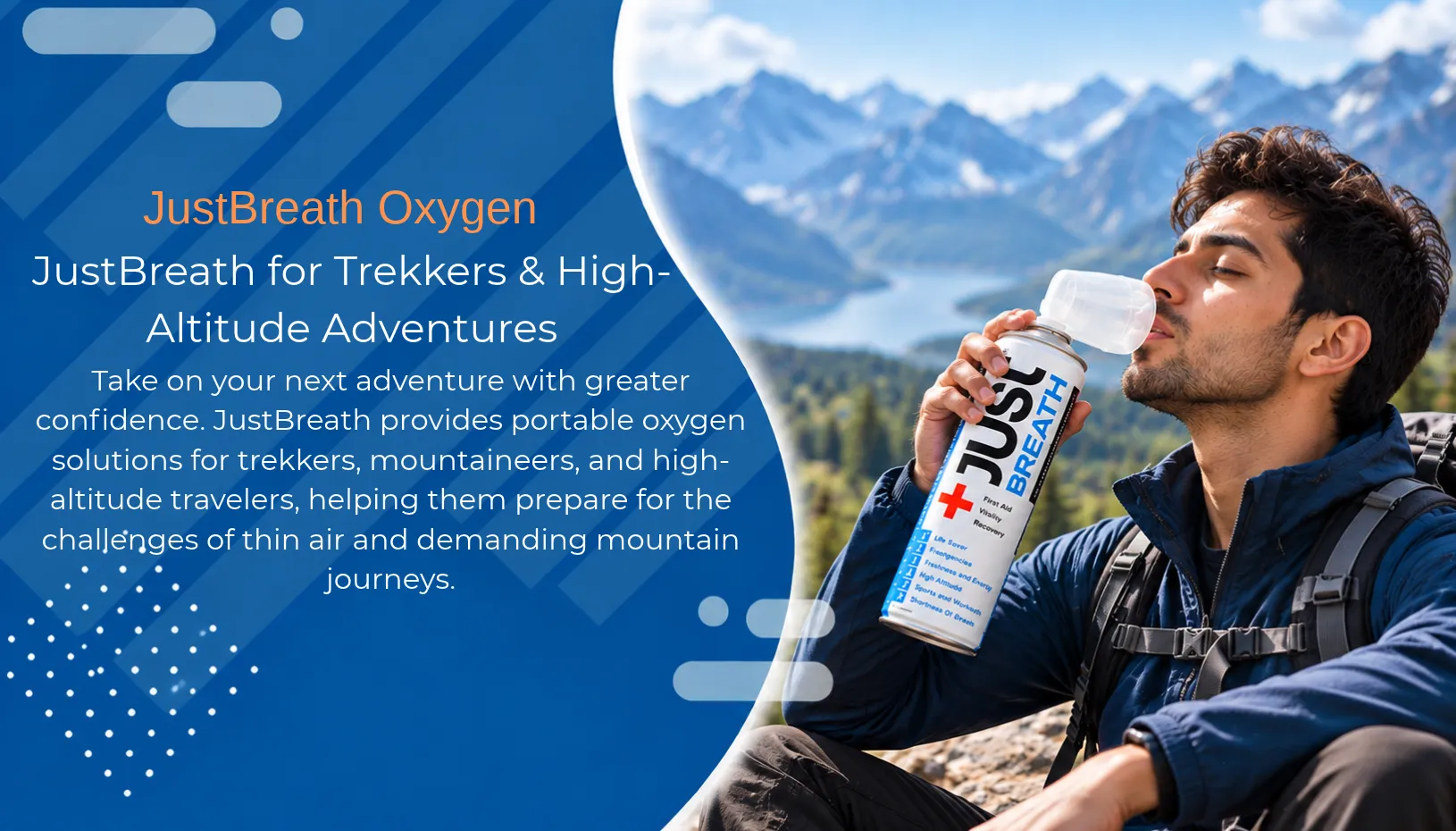
Take on your next adventure with greater confidence. JustBreath provides portable oxygen solutions for trekkers, mountaineers, and high-altitude travelers, helping them prepare for the challenges of thin air and demanding mountain journeys.
Above 2,500 metres, every breath carries less oxygen, and most people feel it: a light headache, shortness of breath on stairs, and poor sleep. Trekkers & High-Altitude travellers, including those visiting Ladakh, carry Just Breathe as an oxygen can for trekking, taking a few breaths of oxygen while resting to make the climb to a guesthouse or high mountain pass feel easier. It works alongside slow ascent and adequate rest. It does not prevent or cure altitude sickness. The same applies to day walks: an oxygen can for hiking above 3,000 m is a lightweight extra, not a necessity.
Most healthy visitors do not need an oxygen cylinder for high altitude trips if they acclimatise properly. Leh sits at about 3,500 m, and most travellers are advised to rest for the first 48 hours after flying in. Where an oxygen can helps is in the moments in between: after the walk up to Shanti Stupa, at a high pass like Khardung La or Chang La where you stop for photos, or on the drive from Manali when you cross several passes in a day. That is why so many visitors pack an oxygen can for Ladakh. More on carrying an oxygen can for Ladakh.
| Place | Approx. Altitude | Typical Use |
|---|---|---|
| Manali, Shimla, Darjeeling | 2,000–2,500 m | Rarely needed |
| Leh, Kedarnath, Spiti Valley | 3,500–3,800 m | A few puffs after exertion in the first days |
| Hemkund Sahib, Gurudongmar, Tso Moriri | 4,500–5,200 m | Carry one; breathless walking is common |
| Khardung La, Chang La passes | ~5,300 m | Short stops only; rest and acclimatise |
An oxygen can for altitude sickness can ease breathlessness for a few minutes, but it does not treat acute mountain sickness (AMS). Mountain-medicine guidelines (Wilderness Medical Society) say the most important treatment for altitude illness is to go down 300–1,000 metres; supplemental oxygen is used while waiting to descend or during descent. A 12 L can holds only a few minutes of oxygen, so an oxygen can for altitude sickness cannot replace a proper oxygen supply or evacuation. Read more: oxygen can for altitude sickness.
Go down now if: headache gets worse despite rest and water, you vomit, you feel breathless while resting, you are confused or unsteady, or you cough frothy sputum. These are signs of serious altitude illness
| Trip | Suggested Stock Per Person |
|---|---|
| Weekend trip to 3,000–3,500 m | 1 can |
| Ladakh road trip, 5–7 days | 2 cans |
| Trek above 4,500 m / Manali–Leh ride | 2–3 cans |
| Group leader's kit | 1 extra can per 4 people |
Keep the can in your daypack, not at the bottom of a duffel. Carry it by road: most Indian airlines do not allow canned oxygen on board, so buy in Leh or carry it in the car. See oxygen can rules for flights in India
A can weighs a few hundred grams and needs no regulator, so it suits individual trekkers. An oxygen cylinder for trekking holds far more oxygen but needs a regulator, mask and refills; expedition teams and tour operators carry these for emergencies. Many groups carry both: an oxygen can for trekking for each person, and an oxygen cylinder for trekking with the guide. If you have been searching for an oxygen cylinder for high altitude, that guide’s cylinder is it, because it needs a trained person to set the flow; for each trekker, a light oxygen canister is the practical choice.
Adjust the plan to your route, and turn back if anyone has warning signs.
Carry one extra oxygen canister for every four people, kept with the leader. Brief the group on day one: how to use the can, the warning signs, and that anyone who feels worse must say so. Note who used the can and when, so the leader can spot someone who needs it again and again – that person should rest or go down, not keep climbing. Leaders planning an oxygen can for trekking groups should budget one can per person plus the spares.
Pack a pulse oximeter, warm layers, sunscreen, a refillable water bottle and your regular medicines. Ask your doctor before the trip about medicines for altitude sickness; do not start any medicine on your own. Hikers on shorter trails can use the same list; an oxygen can for hiking fits a hip-belt pocket.
A portable oxygen can can be a convenient addition to your mountain travel kit when used appropriately. Whether you choose an oxygen can for trekking, an oxygen can for hiking, or an oxygen can for Ladakh, understand the product’s limitations and plan for the altitude you expect to encounter.
For more demanding expeditions, consider whether an appropriate oxygen cylinder for trekking or an oxygen cylinder for high altitude is needed as part of a broader emergency preparedness plan. Remember that gradual ascent, acclimatisation, symptom awareness and timely medical care remain essential for safer mountain travel.
It is a sensible light addition above 3,500 m, as long as you still acclimatise and know when to descend. A 12 L oxygen canister weighs only a few hundred grams, so it costs little space in a daypack.
About 400 g full , far lighter than any oxygen cylinder for trekking.
Yes, but keep it inside your pack; very cold cans release gas more slowly.
Some chemists in Leh stock them in season, but supply varies; it is safer to carry yours by road
Only under adult supervision and with a doctor's advice before the trip.
Most healthy pilgrims manage without one, but Kedarnath is about 3,500 m and the climb is steep. Carry one can, walk slowly and rest often. The same advice applies to an oxygen can for Ladakh trips.
It gives about the same number of puffs as at sea level; you may simply use it more often. Two cans cover a week in Ladakh for most travellers.
No. Resting and climbing slowly lets your body adapt; no oxygen can for trekking replaces that. A can only eases breathlessness for a few minutes.
On day hikes below 3,000 m most people do not need one. On high day trails, such as the walks around Leh or in Spiti, an oxygen can for hiking is a light comfort for steep sections.
Headache, nausea, tiredness, poor sleep and loss of appetite, usually within the first day at altitude. Rest, drink water and do not go higher until they settle. An oxygen can for altitude sickness symptoms may ease breathlessness while you rest, but go down if they get worse.