
Oxygen Can for Travel: Can You Carry It on a Flight in India?

Table of Contents

Expert Guidance Awaits
Just Breath oxygen can for travel with an airplane window, illustrating airline rules for carrying an oxygen can on a flight in India.
Can you carry an oxygen can on a flight in India? Understand airline rules and travel guidelines before packing your oxygen can.
Every April, give or take a week, our phones in Udaipur start ringing with the same question. The caller has usually booked a Delhi to Leh flight, the suitcase is half packed, and there’s an oxygen can lying on the bed next to the woollens. “Can I just throw this in my bag?” We get why people ask. An oxygen can for travel doesn’t look like anything worth worrying about. It weighs next to nothing, it fits inside a shoe, and you bought it to feel better, not to cause trouble. Airports see it differently, though. To a security screener, it’s a pressurised container holding an oxidising gas, and that changes the conversation. So we’ll be straight with you. We’re not going to say “yes, it’s allowed” or “no, it’s banned,” because neither is true across the board. Whether you can carry oxygen can in plane baggage depends on your airline, the product, and rules that get updated from time to time. What we can do at Just Breathe Oxygen is walk you through how the oxygen can flight India question actually gets decided, so you’re not caught out at the X-ray belt. Quick answer: It depends. Whether an oxygen can for travel is allowed on a flight in India depends on your airline, how the product is classified, and the current DGCA and BCAS rules. Many airlines restrict compressed oxygen in both cabin and checked baggage. Confirm with the airline in writing before you fly, and keep a plan to buy one at your destination if they say no.

Why Pressurised Containers Are Regulated on Flights
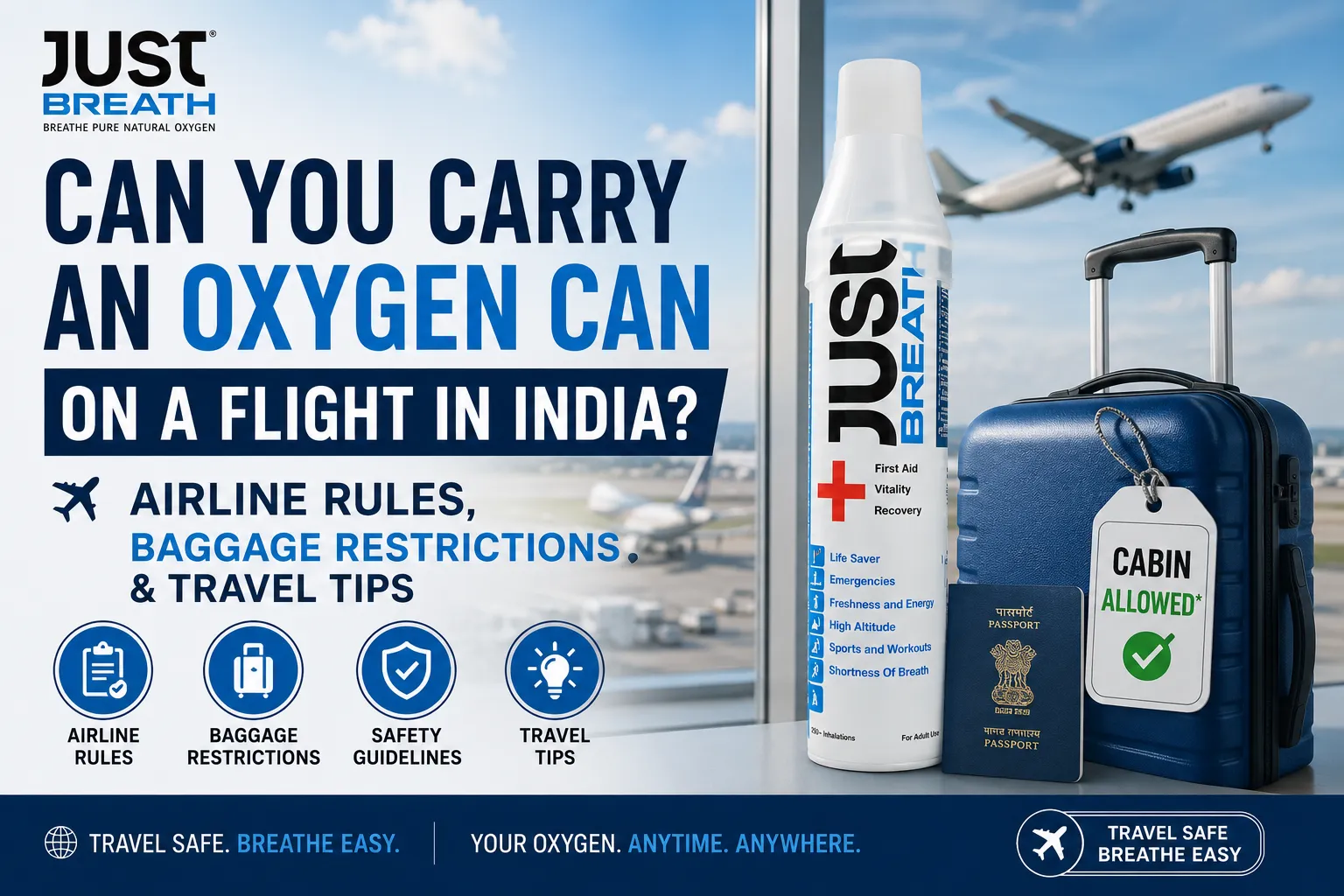
Just Breath oxygen can with suitcase and airplane illustrating airline rules and baggage restrictions for carrying an oxygen can on a flight in India.
Can you carry an oxygen can on a flight in India? Check airline rules, baggage restrictions, and essential travel tips before flying.

The can doesn’t know you’re at 35,000 feet

A plane’s cabin isn’t kept at ground-level pressure. Once you’re cruising, it feels more like sitting somewhere between 6,000 and 8,000 feet. You notice it in your ears. The can notices it too, in its own way: the gas inside stays at whatever pressure it was filled at, while the air around it thins out. Add a few rough rides on the baggage belt and some temperature swings, and regulators have good reason to be fussy.

Oxygen won’t catch fire. Everything around it might.

This is the bit most people haven’t thought about. Oxygen itself isn’t a fuel, but it feeds fire, and generously. A tiny spark near a leaking oxygen source burns hotter and spreads faster than it would in normal air. That’s why compressed oxygen sits on the dangerous goods lists airlines work from. Your recreational tank can holds a fraction of what a hospital tank does, but it’s the same gas, and a full oxygen cylinder for travel gets watched even more closely.

So who decides the oxygen can airline rules?

Broadly, three groups. International bodies like ICAO and IATA set the dangerous goods framework most airlines follow. In India, the DGCA looks after aviation safety (dangerous goods included), and BCAS runs security screening and keeps the list of prohibited items. Then each airline adds its own layer on top, and airlines are free to be stricter than the regulators. That’s why two friends flying on the same day can get two different answers. One airline might allow it with conditions. Another won’t touch it. The officer at the screening point may even have a fresh instruction you’ve never heard of. Annoying, yes, but that’s how oxygen airline rules play out in real life.

Cabin vs Checked Baggage: General Principles

Cabin bags

A lot of travellers figure the cabin is safer because the can stays with them. For a few small gas cartridges, airlines agree. Oxygen is a different story. Your deodorant might be fine in the cabin, and that tells you nothing about whether you can carry oxygen can in plane cabins. They’re classified differently, and screeners know it.

Checked bags

If anything, the hold is stricter. Nobody’s down there to spot a problem, so airlines that allow some gas containers tend to keep them out of checked luggage. Please don’t hide a can between your sweaters and hope for the best. It shows up clearly on the scanner, and the likely result is your bag being pulled aside, the can taken out, and you running late for boarding.

If someone actually needs medical oxygen

This is a separate track altogether. Passengers with a diagnosed condition usually go through the airline’s special assistance team, often with a medical form signed by their doctor. Some airlines provide oxygen on board, and some accept approved portable concentrators. A personal oxygen cylinder for travel normally goes through this route, not regular baggage. A recreational oxygen can for travel doesn’t replace any of it, and the check-in desk won’t treat it like it does.

Who to Call Before You Fly: Airline and Airport Checklist

What to ask the airline

A phone call is fine for a first chat, but email or the airline’s web form is better, because you’ll want the answer in writing. Mention your PNR and flight numbers, and ask:
  1. Is a small consumer oxygen can (say the size, for example 12 litres) allowed in cabin baggage on my flight?
  2. Is it allowed in checked baggage?
  3. Do I need to declare it at check-in?
  4. Is there a limit on how many I can carry?
  5. Does the answer change on a connecting or codeshare flight?

If the person on the phone says “should be okay,” thank them and still ask for an email. “Should be okay” won’t get you very far at the security gate.

Don’t forget the airport

The airline saying yes doesn’t mean security will. Check the latest BCAS prohibited items list a few days before your oxygen can flight India trip. Flying out of a smaller airport? Ring their information desk. A high-altitude airport like Leh may handle things differently from Delhi or Mumbai, simply because of the kind of passengers it sees.

Keep the proof handy

Save the airline’s reply offline on your phone and print a copy. Counter staff change every few hours. A printed email doesn’t.

Documents and Product Labels to Carry

What the label should tell a stranger

If the airline has cleared you to carry oxygen can in plane baggage, think about the screening officer who has never seen your product before. The can should tell them, at a glance, who made it, what’s inside and how much, the stated purity, how to use it safely, and the batch and expiry details. A can with a peeling sticker, or one shifted into some other container, is the one that gets confiscated.

What to keep in your travel folder

The airline’s written approval, your purchase invoice, and the product’s safety data sheet if the maker provides one. If there’s room, carry the original box too. It answers half the questions before anyone asks them.

Will a doctor’s letter help?

For prescribed equipment, or an oxygen cylinder for travel arranged through the airline, it often does, and it may even be required. For a recreational can, it rarely changes the decision. Don’t build your plan around it.

Alternatives if the Airline Says No

Couriering it ahead

Some people try sending the can to their hotel by courier. Check first. Most couriers have their own dangerous goods policies, and plenty refuse pressurised gas outright, especially for air shipments. Whatever you do, don’t describe it as something else on the form.

Driving the last stretch

Going to Ladakh in season? The Manali to Leh and Srinagar to Leh highways are an option. The slow climb also gives your body time to adjust, which might do you more good than any can. If you’re not driving yourself, check with your bus or taxi operator.

What a can can’t do

Let’s be clear about this. An oxygen can for travel is a handy thing to have. It is not a cure for altitude sickness. Rest on your first day, climb slowly, keep drinking water, and if the headache, nausea or breathlessness gets worse, head lower and see a doctor. That advice beats any product, ours included.

Buying at Destination (Leh, Srinagar, Bagdogra)

For a lot of travellers, the simplest way around the oxygen can airline rules is to not fly with one at all. Buy it when you land.

Leh

During the season, you’ll find oxygen cans at chemists, in shops around the main market, and at many hotels. It makes sense, since most visitors land straight from the plains. In fact, a good number of the oxygen can flight India calls we take end with us saying, “just pick one up in Leh.” Buy it on day one, though. Stock runs low in peak weeks and prices move around.

Srinagar

The city sits at a comfortable height, so you probably won’t need oxygen there. Heading to Sonamarg, Gulmarg or across Zoji La is a different matter. Pick up an oxygen can for travel in Srinagar before you leave town, because shops get scarce as the road climbs.

Bagdogra (for Sikkim and Darjeeling)

Bagdogra is on the plains, but the drive to Gangtok, Darjeeling or North Sikkim climbs fast. Siliguri, practically next door to the airport, has chemists on most streets. Stock up there, especially if Gurudongmar Lake or Nathu La is on your list.

Before you hand over the money

Look at the seal. Look at the expiry date. Make sure the label actually names a manufacturer, and if it doesn’t, put it back. Our travel and high-altitude page has more tips for planning a mountain trip.

Conclusion

So, can you take an oxygen can for travel on a flight in India? Sometimes. With the right airline, a properly labelled product and approval in writing, it may work out. Often it won’t. Either way, the final word belongs to your airline, working within DGCA and BCAS rules that can change, so check fresh before every trip instead of going by what a friend did last year. Ask early. Keep your label and papers in order. Don’t argue at the gate. And if the answer is no, don’t stress, because Leh, Srinagar and Siliguri are well set up for exactly this. An oxygen can for travel is best seen as one small part of a sensible trip, next to a slow ascent and a bit of patience with your own body. You can explore our cans on the Just Breathe Oxygen home page or read our guide for trekkers and high-altitude travellers.

Frequently Asked Questions: Oxygen Can for Travel on Flights in India

Related Blog